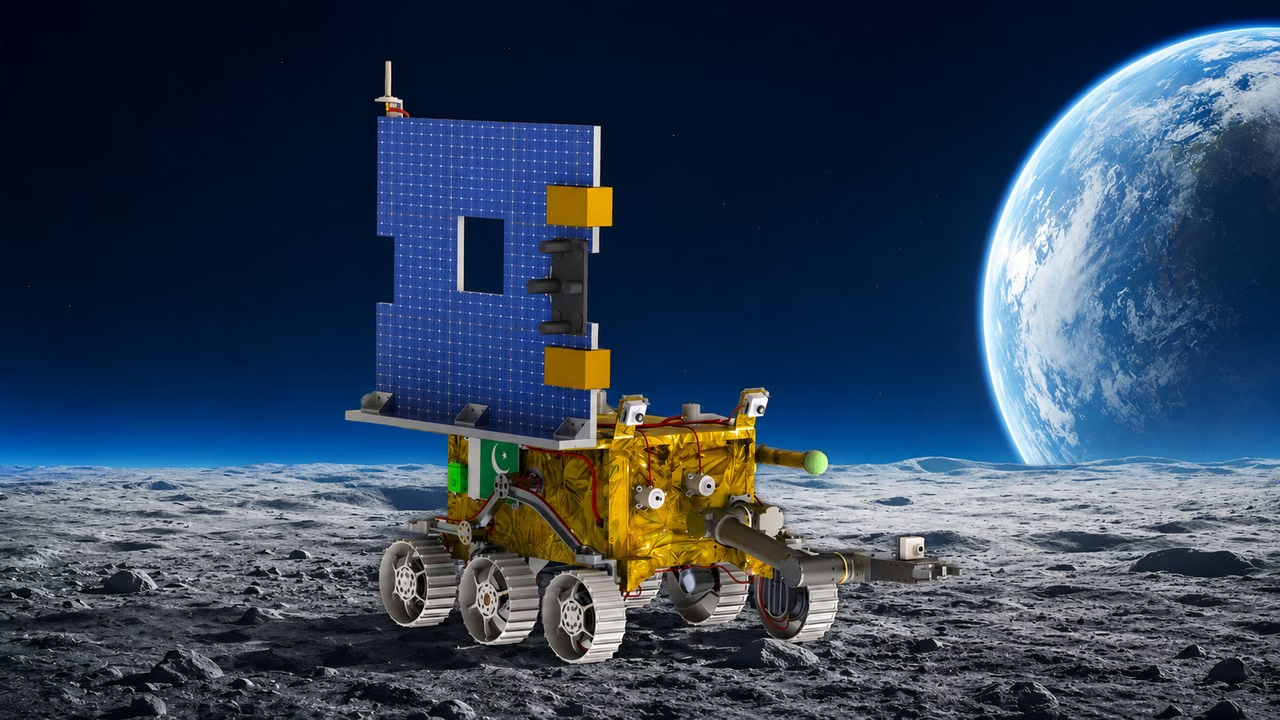
Pakistan has officially named its first-ever lunar rover Jinnah-1, marking an important milestone in the country’s growing space exploration program. The name was selected following a nationwide competition that attracted thousands of proposals from people across Pakistan.
The Pakistan Space and Upper Atmosphere Research Commission (SUPARCO) announced the name after a jury reviewed more than 4,000 entries submitted from across the country. The selection of “Jinnah-1” gives Pakistan’s first lunar rover a name associated with the country’s founder and its national identity.
Jinnah-1 is scheduled to travel to the Moon’s south pole in 2029 as part of China’s Chang’E-8 mission. The mission is expected to provide Pakistan with an opportunity to participate in advanced lunar exploration and scientific research.
The locally developed rover will carry scientific instruments designed to study several aspects of the lunar environment. Its planned research activities include examining lunar plasma and radiation and collecting information about the geological characteristics of the Moon’s surface.
The rover will also conduct scientific experiments that could contribute to a better understanding of conditions on the lunar surface. Such research is becoming increasingly important as international space agencies and countries explore possibilities for longer-term lunar missions.
The Moon’s south pole has attracted significant international scientific interest because of its unique environment and the possibility of resources such as water ice in permanently shadowed regions. Future lunar exploration could help researchers better understand these areas and their potential value for sustained human activity.
For Pakistan, the Jinnah-1 mission represents an opportunity to strengthen its capabilities in space science, engineering and planetary research. Developing a lunar rover locally also highlights the growing role of Pakistani scientists and engineers in advanced space-related projects.
The rover’s participation in the Chang’E-8 mission is part of broader international efforts to explore the Moon and develop technologies that could support future missions. Scientific data gathered by Jinnah-1 could contribute to research on the lunar environment and help build technical expertise for future Pakistani space missions.
The nationwide naming competition also generated public interest in Pakistan’s space program. More than 4,000 proposals demonstrate the level of interest surrounding the country’s first lunar rover and its future role in space exploration.
The name Jinnah-1 is expected to become closely associated with a new chapter in Pakistan’s space journey. If the mission proceeds according to schedule, the rover will reach the Moon in 2029 and begin its planned scientific activities at the lunar south pole.
The mission could ultimately serve as a foundation for further Pakistani participation in lunar and planetary exploration. It may also encourage students, researchers and young engineers to pursue careers in science, technology, engineering and space research.
With Jinnah-1, Pakistan is preparing to take another significant step beyond Earth and contribute its own scientific instruments and expertise to the exploration of the Moon.